Week #811
This week summer seemed to have abruptly ended and fall/winter has arrived. We’ve moved back into work mode and started to run.
This week we continued to debug some of the WebRTC issue reported. The client was complaining things were moving slowly, so we offered to have more frequent, shorter check-in meetings. Everyone agreed, and then it hasn’t happened for 2-3 weeks. 🤷🏻♂️ When we get bug reports, we try to fix them quickly and ask for a meeting so we can iterate, but no reply.
On the LED front, we’re continuing to debug, iterate and fix minor issues with both the microcontroller software, but also the iPad app that sends the commands for which LEDs to light-up. We’re very close and the deadline is looming. Some of the team in NYC goes over to the model maker’s office and we have marathon video calls to work through and debug any issues in real time. As they continue to wire and re-wire, we seem to take a few steps backwards. Hopefully by next week, we wrap-up everything.
On Thursday, we published our article about UK Public House names. This was a side-quest that was spurred on by a throw-a-way comment on a podcast we were listening too.
(You can tell we’re avoiding real work) We also sat down and re-created a test stereogram (those magic eye posters from the 90s). The images in those posters were always dolphins, cubes, landscapes, etc. We wondered how to construct our own and if it was easier 30 years later? It turns out, it is pretty easy, but the subject matter and composition are key.
There are plenty of websites to help you make stereograms. Usually you just need a depth map of the image. It then uses a noise pattern and that depth map to make some offsets in the final output. Previously, to make those depth maps you needed to make some 3D objects in software and then position a camera. It wasn’t trivial and you needed to recreate everything you wanted in your picture. Fast-forward to the 2020s and you have smart phones with LIDAR that produce depth maps with your portrait photos! It is pretty easy to extract those black and white depth maps, so we did.
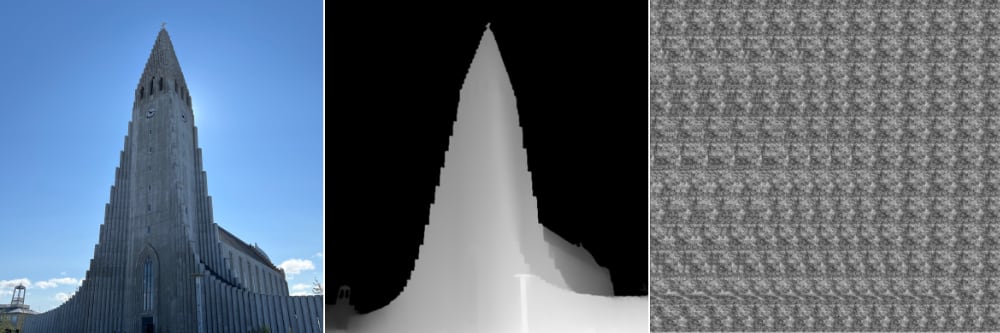
Friday we continued to do some digital house-cleaning. We also had a meeting about the WebRTC project and we continue to find small bugs, but have shifted gears a bit back to using Apple Continuity Camera rather than our own home grown WebRTC version (for now).
On the PETALS project, we added Lemon Squeezy as our checkout/payment system to take subscriptions. There is a free trial when you sign-up so your credit card only gets billed after 7 days. Low-and-behold, that’s a boon to credit card fraudsters. We’ve got endless fake sign-ups over the weekend. They obviously have a list of stolen card numbers and need to test to see if they are still active or not. If they do that on a large retailer like Amazon and the card is already blocked or marked as fraud that’s problematic. So they first find a service that has a free trial – like PETALS and run the card to see if it is valid. If it is, it hasn’t been charged and thrown-up any flags (yet), so they know they can use that valid, working card at other retailers immediately. We’ve been playing whack-a-mole with them all weekend, but the way lemon squeezy was originally setup by us, that makes it very difficult along with invalidating all these fake purchases to now ruin our charge-back reputation. Good times.
Week #812
This week we properly started a bunch of new surveys and are gearing up for more in October and November. As part of that process we continue to improve our backups. We found some weak spots and fixed it with redundancy L-O-C-K-S-S (Lot of Copies Keeps Stuff Safe). We have a draft article outline all this in more detail.
We continue debugging some of the WebRTC code and also the LED code. Things are in a good place, but (as always) it is hard for us to debug in real-world situations. The WebRTC echo is partly due to geography and network latency, VPNs can help, but real testing is always best. On Tuesday, we were told by the client to stop working on it. They are getting cold feet, so we feel this project has run its course. Our normal Friday meeting was even canceled.
The LEDs are a similar story, we have a roll of 300 LEDs to help us test, but the final product has 15x so we test in parts where we can and then try to integrate everything and work with the New York team to test.
For the old Spellstruck project, we were originally call upon to help with the analytics, but idle hands are the devils work. While we waited for everything to get instrumented, we helped with the push notifications. That meant dealing with certificates, AWS lambda functions and simple queues. Which now is partly our responsibility to update the certs annually and keep the code versions up-to-date. This week we had to migrate the Heroku Postgres database from version 15 to 18. We ran the tests, add the follower, let it all sync for a day, then put things into maintenance mode and did the swap. It’s not difficult, but can be stressful if something goes wrong.
Using cloud services is great, but they periodically end support for software versions you are using, so you need to go back to things that work just fine, upgrade them and potentially introduce errors.
For yet another project, we are getting into the HubSpot API. We have various forms to collect information at the top of a sales funnel. To start with, we just want to capture that data and organize it into various models in HubSpot. Once the data is correctly flowing in, we can start to do some smart stuff with it.