We were listening to a podcast about Anne Bonny and Mary Read: real-life pirates of the Caribbean. Mary Read and her husband opened a pub called The Three Horseshoes and the presenters commented about how it was a nice name. That set us off on a quest.
We’ve heard the trope that all the pubs in the UK have either an animal, plant or body part in their name: The Red Lion, The Pear Tree, The Athletic Arms. The Three Horseshoes fit the template. But how true was it?
Step 1: Find the Data
We needed to find a decent list of UK pubs and it turns out that you can download a CSV of 50,000 registered public houses. This is a list from 02024, so your favorite place may or may not have made the cut. Also, what a company trades as and what’s on the door are not guaranteed to be the same either.
Using: https://www.getthedata.com/open-pubs we downloaded the list of pub names. The CSV contains a list of names, addresses, post codes, cities, and additional columns. All we were concerned with was a list of distinct names and their frequency.
That was pretty easy to do, but we quickly spotted some problems. Was The Fox and Hound the same as The Fox & Hound or even Fox and Hound?
Step 2: Data Cleansing
Now that we had the list, we needed to normalize it and collapse similar names. Ignoring the capitalization Fox and Hound versus Fox and hound we quickly did some find and replacing on punctuation, spelling and removed (at the …) and (Bar Only), Ltd. and a few other common strings. Since we knew this was going to be an alphabetically sorted list, we also moved any “The XYZ…” to “XYZ…, The”. The final output is much easier to search and browse manually.
This collapsed the list from around 50,000 pubs to around 27,500 distinct names and their corresponding frequency.
But that’s all the pub names in the UK, we are only interested in those with animal, plant or body parts. We made a big list of words and went through each of the 27,500 and tested to see if they contained anything in our list. That got us down to about 10,000 rows or 1 in 5 pubs in the UK contain the trope. When we counted those names by frequency we had 3,000 rows of distinct pub names and their frequency count.
Step 3: Curation
Now that we had only 3,000 rows to review, it made things easier to go over manually and curate. Our goal wasn’t a comprehensive list or any exact numbers. At this point we just wanted a list of real pub names you might find when you needed to make-up a quick name for a pub in the UK. The Quill and Porcupine, The Dragon’s Arms, The Bear and Boar.
Sorting the list alphabetically and browsing through we found some false positives: John Bull Inn, that’s a surname not directly an animal reference. So we remove those. We also found lots of White Stag at the XYZ usually the city name. We further collapsed those into just White Stag, similar for some chains: Slug and Lettuce / X / Y / Z was very common where they seemed to be paired with other restaurants, again we just collapsed those down to Slug and Lettuce.
After reviewing that list a few times, we were happy with what we managed to curate. The next step was to put it into some chapters and columns with some nice headers and engraving images to make a nice book from this work and research.
Step 4: Stats
When we sorted by frequency we got the top 50 common UK pub names with an animal, plant or body part in the name.
- Red Lion, The
- Royal Oak, The
- White Hart, The
- Swan, The
- White Horse, The
- Rose and Crown
- Wheatsheaf, The
- Black Horse, The
- Greyhound, The
- White Lion, The
- Coach & Horses
- Three Horseshoes, The
- Fox and Hounds
- George & Dragon
- Black Bull, The
- Bull, The
- Bulls Head, The
- White Swan, The
- Fox Inn, The
- Golden Lion, The
- Nags Head
- Lamb Inn, The
- Horseshoe, The
- Black Swan, The
- Cock Inn, The
- Bay Horse, The
- Beehive, The
- Eagle, The
- Horse & Jockey
- Barley Mow, The
- Grapes, The
- Griffin, The
- Horse and Groom
- Dolphin, The
- Green Dragon, The
- Vine, The
- Black Lion, The
- Woolpack, The
- Shoulder of Mutton
- Slug & Lettuce
- Stag, The
- Lion, The
- Talbot, The
- Bear, The
- Bird in Hand
- Pheasant Inn, The
- Cherry Tree, The
- Peacock, The
- Falcon, The
- Phoenix, The
First place was The Red Lion with ~450 pubs using that name. In second was The Royal Oak with ~350. Third was The White Hart with ~230 and continuing to drop to a long tale of names.
In 12th place The Three Horseshoes! It turns out to be a pretty common name for a UK pub.
If we break it down by what terms the pubs fell into (and they could be in multiple) we can see that Animals are by far the most popular in names.
| Category | Distinct names | Pubs | Share | Leaders |
|---|---|---|---|---|
| Animal | 1,894 | 6,401 | 12.8% | lion 808, horse 728, swan 446, fox 321, bull 290 |
| Plant | 906 | 2,294 | 4.6% | oak 495, tree 307, rose 287, wheatsheaf 170 |
| Body part | 321 | 1,138 | 2.3% | head 815, hand 75, feathers 53, shoulder 41 |
| Mythical beasts | 81 | 347 | 0.7% | dragon 177, griffin 58, phoenix 55, unicorn 43 |
Since public houses in the UK date back centuries, their names are often hold-overs from another era. Many of their early patrons were illiterate, so using commonly recognizable symbols were more important than how the pub name was spelt.
Step 5: Publication
Now that we have the curated short list of names, some interesting stats we decided to do something more than just this article. We created several printable publications for anyone to use as an interesting reference.
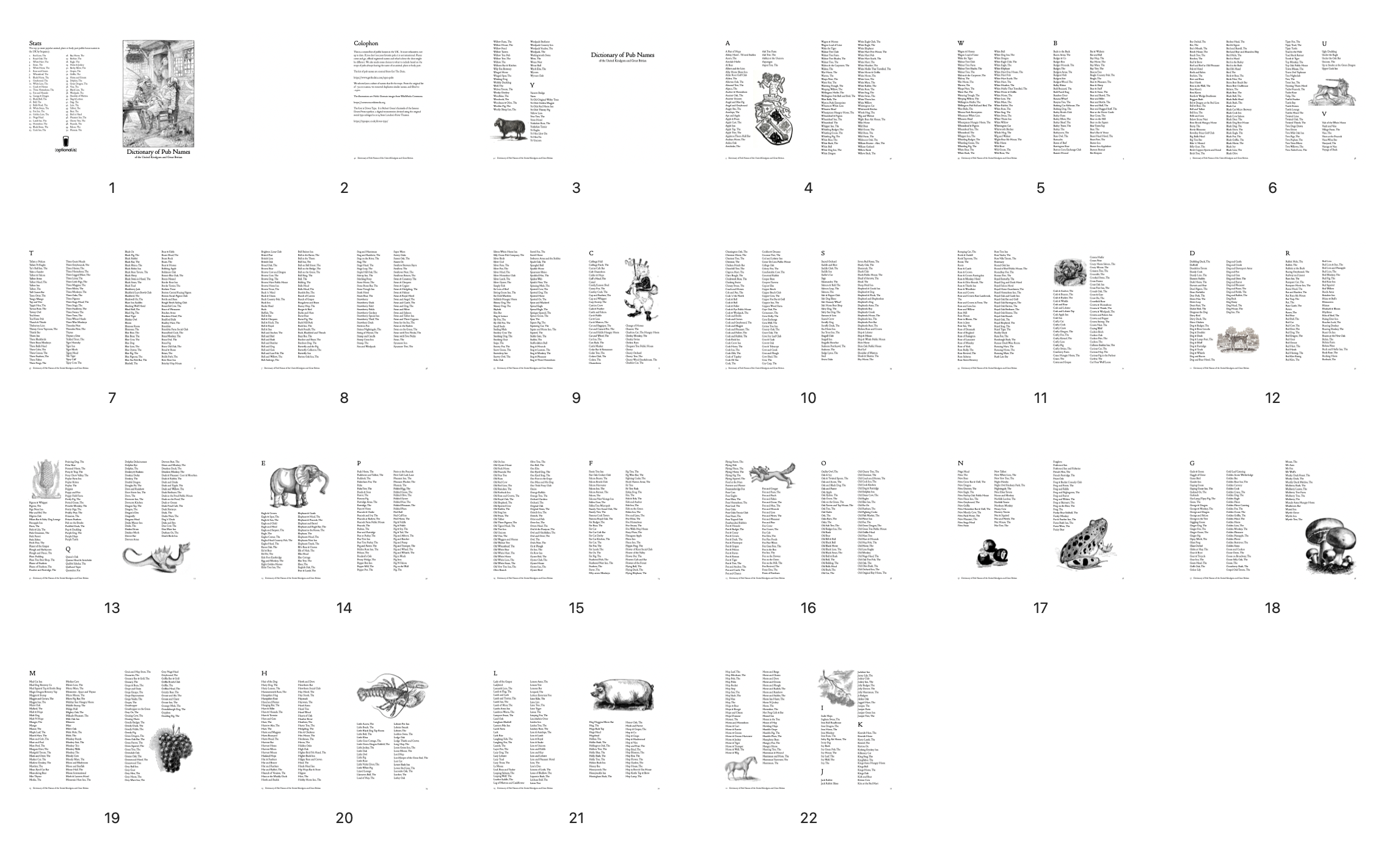
First we copy and pasted the full comma separated text from the most frequent name to the least into a document. It was noisy, cluttered and un-organized. It made no sense to look-up words or find anything. We sorted the words alphabetically, broke them into logical chapters based on their first letter (where we also moved “The” to the end of the names), and put one name per line and made each page two columns.
This was much easier to read, but it still felt very utilitarian – like an ancient pub phone directory. To solve this, we added some illustrations to try and match some of the animals and plants references. This broke-up the text and filled in some blank space. Luckily, there is no shortage of public domain engravings! After an afternoon of figuring out some layout we found plenty of images to fill the gaps.
We made a few different A5 PDFs that you can download and print at home.
- pub_names_A5_booklet.pdf A5 (9.5 MB)
- pub_names_A5_booklet_spread.pdf A4 (10.6 MB)
You can also purchase a 42 page book on Amazon’s using their print on demand service.
- Dictionary of Pub Names Amazon US ($8)
- Dictionary of Pub Names Amazon UK (£6)
- Dictionary of Pub Names Amazon IE (€7)
Conclusion
It’s funny how some small, one off-comment in a podcast can lead down a path of data scraping to publishing a small book.
We hope you enjoy a look into our process, inspiration, thought process and publication.
Cheers, Iechyd da, Slàinte Mhath!