 The Old Icelandic Calendar, called Misseristal (translated as semester count), was started in the 10th century, continued until the 01700s, but its shadow lives on today.
The calendar was designed to have exactly 12 months of 30 days. That’s 5.25 days short of a solar year.
The other unique aspect of the Old Icelandic calendar is that the months always start on the same day of the week. Sólmanuður always starts on a Monday, Heyannir always starts on Sunday. To keep the months starting on the same day of the week, a 4 day month called Aukanætur (Extra Nights) is added in the middle of the 6 months of summer.
That gets us to 364 days, which is divisible by 7 without a remainder. Now the drift each year is only 1.25 days from the Gregorian calendar. To make-up for this, every few years and additional seven days called Sumarauki are added to Aukanætur. This keeps the months consistently starting on the same day and rectifies the drift from the Gregorian calendar.
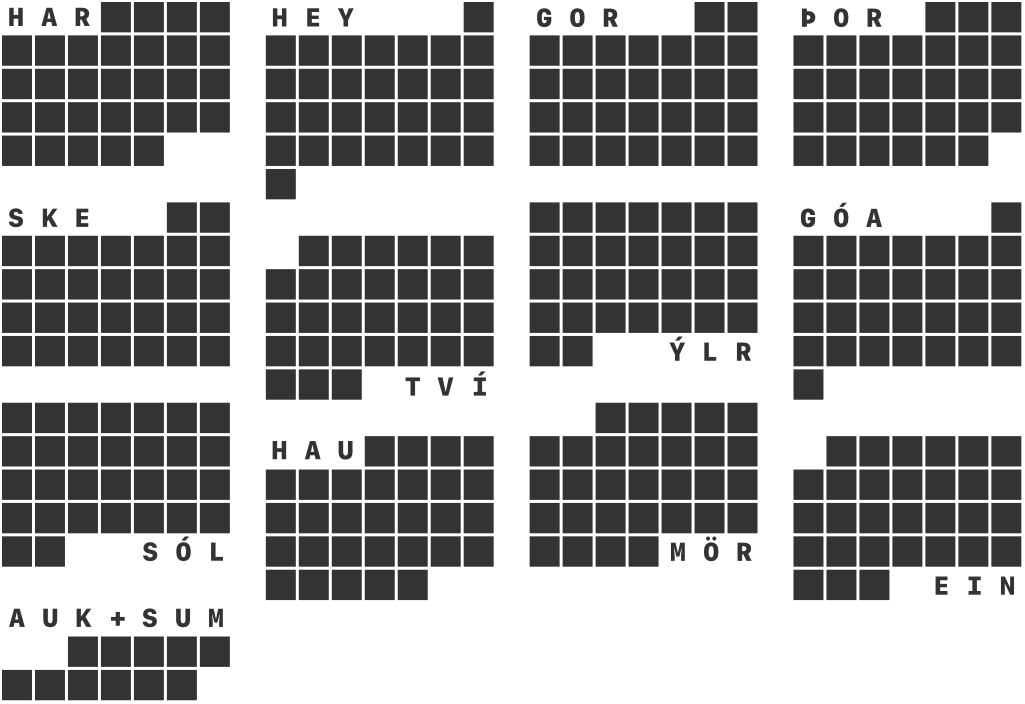
Next week is the start of Aukanætur. It is only 4 days long and there is no Sumarauki this year. This month also means we’re half-way through the six-month summer season. The days are still long, but they are getting shorter as we head towards the autumn equinox.
While the Old Icelandic calendar is no longer used directly, there is still shadow of that old calendar in use in Iceland. For instance, Sumardagurinn fyrsti (The First Day of Summer) is a bank holiday and is always on a Thursday because it is connected to the Old Calendar format. The first day of Gormánuður, the start of the winter season, is becoming an event in Reykjavik, but rather than remind people of winter, it’s rebranded as Kjötsúpudagurinn (Meat-Soup Day). That is always on a Saturday. Bóndadagur (Men’s Day) and Konudagur (Women’s Day) holidays are both the first days of the Old Icelandic winter months of Þorri and Góa. Icelanders still celebrate Þorri with Þorramatur, a smorgasbord of pickled animal parts you’d never normally eat!
Even though Iceland doesn’t use the Old Calendar on a daily basis, it is still used in many other ways.
You can read more about Misseristal and Download an ics calendar file to add the Old Icelandic Calendar to your digital calendar.
Each year we publish an annual A0 wall calendar and include the Old Icelandic Months along side the Gregorian ones. You can download the PDF and take it to any print shop to get your own A0 or A1 calendar poster.