During the Neolithic Era, around 12,000 years ago, humans started to switch from hunting and gathering to agriculture and farming. As time passed and we moved into the Industrial Revolution through to the Anthropocene, we sort of assumed that hunter gatherer way of life is long gone. While for most people, we’re not actively hunting or gathering food, many of us are still in that mindset when it comes to work!
Are you a Hunter Gatherer or an Agriculturalist? Maybe neither, but you work for one?
Hunter Gatherers are always on the move to try and find their next meal. Sometimes it is big project, sometimes small. Projects come in waves and seasons, and they need to hunt and much as they can all the time, because they know there will be feast and famine times. When is the question. Being a Hunter Gatherer can be very rewarding, you spend time on your own and can pick and choose your projects at will.
Agriculturalists have a more steady stream of work. They spent the time and effort to build their own products and reap the benefits. Having your own farm producing for you can lessen the feast and famine that Hunter Gatherers experience, but by no means are you safe. Other Agriculturalists could create bigger or better farms or sell their goods for cheaper. Not to mention you might be growing something that no one wants, which means it is hard to sell to make a living. Agriculturalists have the ability to scale-up their team and product much better than a Hunter Gatherer, but they are a commodity and that is always taken into consideration when selling.
Maybe you are neither a Hunter Gatherer nor own a farm, but you will either be part of a Hunter Gathering team or work for an Agriculturalist. Both have their benefits. When you are an employee it isn’t your decision about what to hunt or grow, you just turn up to help and are doled out a portion for your effort. You don’t get to call the shots, but you tend to get a meal ticket with less stress.
Working on a farm can be easy or hard. You put in your time and if what you sell is in demand, then times are good. Job security is solid and the farm becomes a cash cow. The downside is that you are just another farmhand clocking-in and working for someone else’s vision.
Being part of a Hunter Gatherer team means that every day could be a different project, a different location and maybe different collaboration with team members. This little tribe can become infamous for their work and make very good money in a short amount of time, but the risks are high. As a team member you will get your cut of the reward, but only if there is a reward. If you go hungry for enough time, the Hunter Gatherer tribe will disband. You could loose out big, not having any rewards for a while.
Neither of these situations are ideal, but over time the entropy of Hunter Gatherers tends to be less nomadic and chaotic and eventually settled down to Agriculturalists. With consolidation there are less and less farm owners or chieftains and more and more employees working for large scale farms or tribes.
In Iceland, Hagstofa Íslands has an online tool statice.is to get lots of data about the country. We pulled out the data set Active enterprises broken down by NACE classification and persons employed size classes 2003-2020.
From that we created a series of charts to show how many ‘small’ companies, most likely Hunter Gatherers versus larger companies, Agriculturalists.
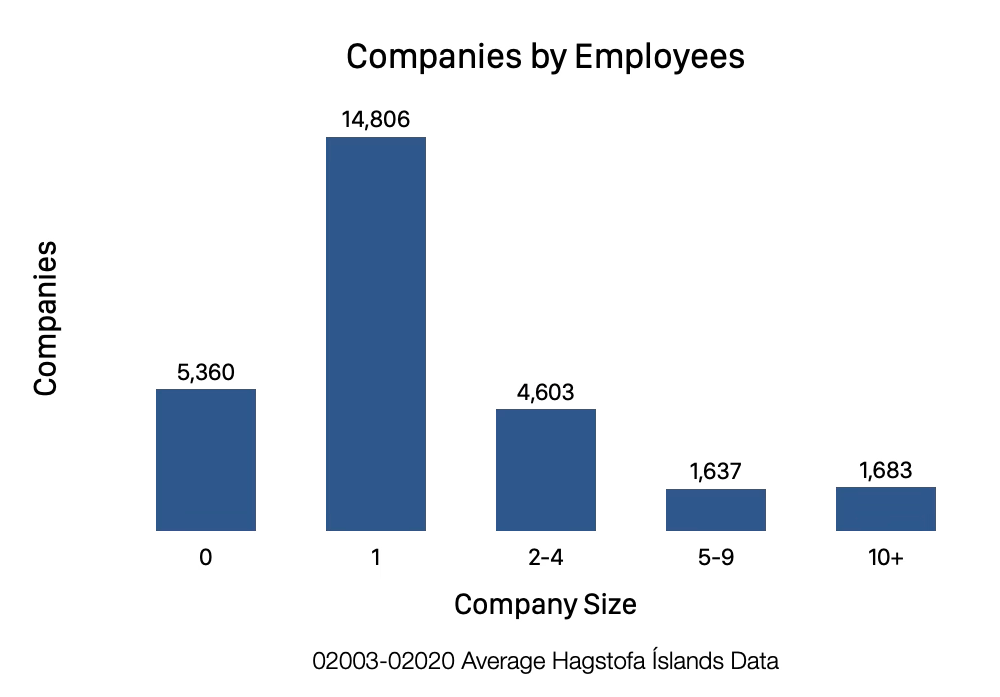
We can see that there are 14,806 companies (on average each year between 02003-02020) with only 1 employee, 4603 with 2-4 employees, 1637 with 5-9 employees and 1682 with 10+ employees. That looks a lot like a power law distribution! With the small exception of slightly more 10+ employee companies.
How big are the 10+ companies on average? We charted the data to see how many employees there actually are per company.
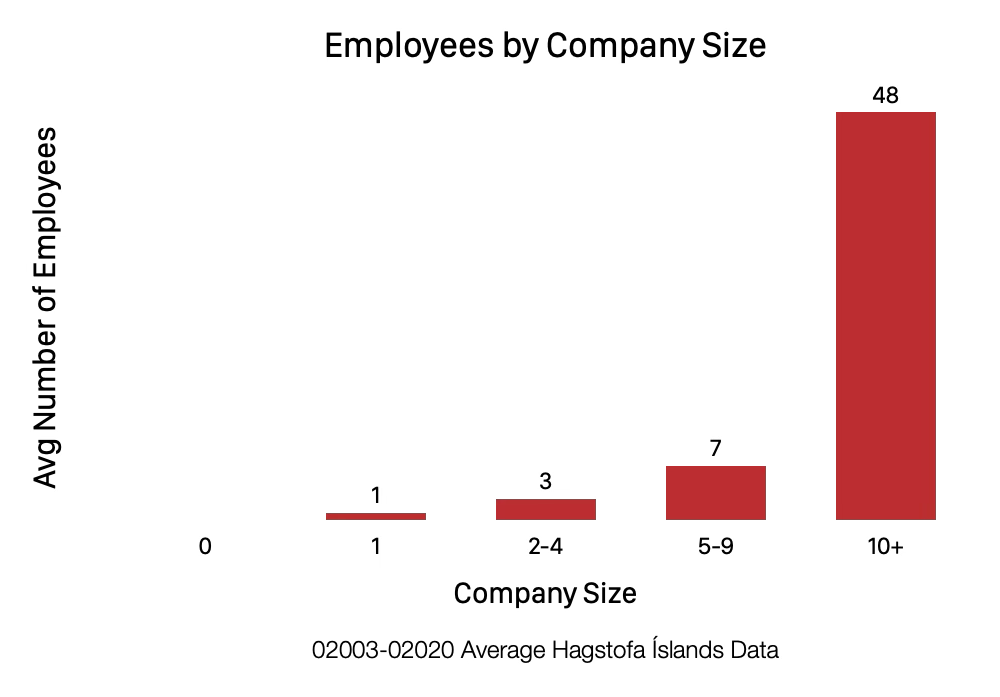
It turns out they are big! With an average of 48 employees. That’s also probably skewed since some organizations like schools, enterprise tech companies, telcos, government organizations, fisheries, and tourism companies probably employ hundreds of people, but there are few of them.
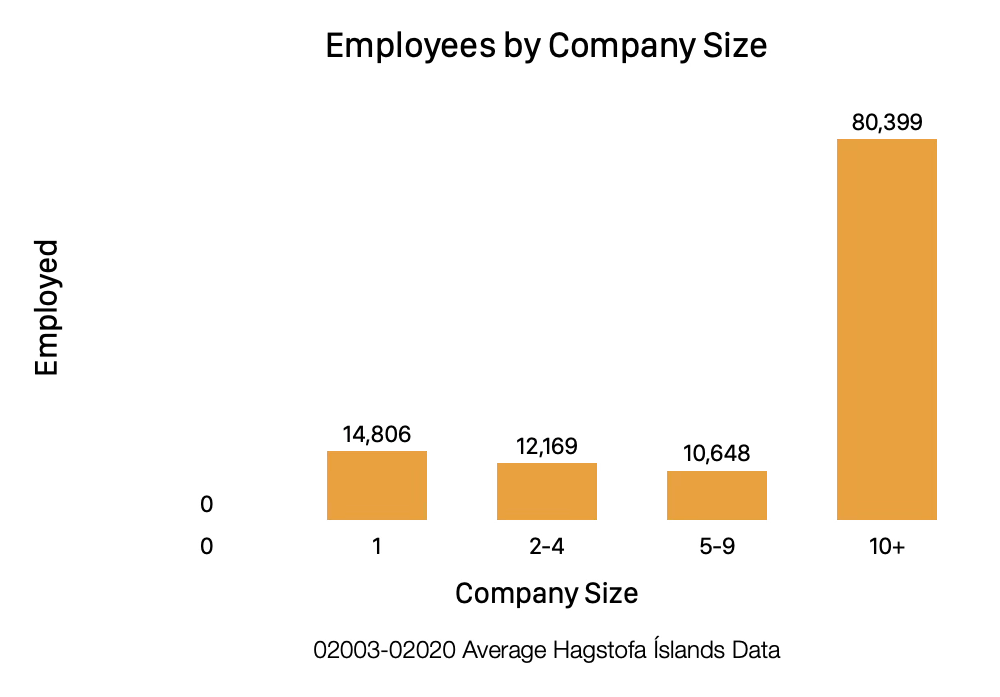
We can chart the actual number of people employed in each bucket to better see that the 10+ companies (who have roughly the same number as 5-9 person companies), account for nearly 8x the people.
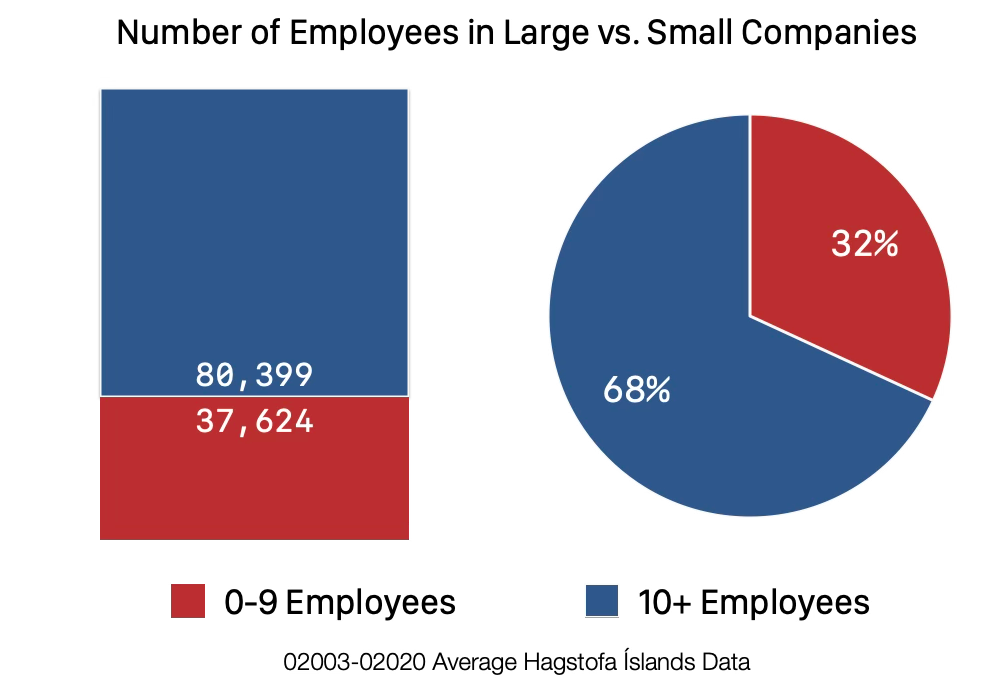
When we compare small companies (0-9 employees) versus large companies (10+ employees) we can see that it is about a 1/3 to 2/3 split. Those large companies are certainly not Hunter Gatherers in our sense of employment. You might describe the whole fishing industry as exactly hunting and gathering, but the workers are paid salary (or shares) from the mother company, they are not looking for the next project independently they have a singular common goal.
That leaves us with the 1/3 of companies that are less than 10 people. Many of those will be small business; shops, restaurants, etc. Those are not project-based. Also, there are a lot of 0 person companies. These are inactive or holding companies for “tax reasons”. 22.8% of people work in a company 4 people or smaller (but there could be some overlap if you own/work for multiple small companies).
If we had to estimate, we’d probably say 5-10% employees are actual project Hunter Gatherers. These are the folks who are single or super small teams whose paycheck directly depends on how much work they bring in. The other 90-95% of people are Agriculturalists who are paid salary from a company for their work. (These numbers seem very distorted since we know lots of artists, musicians and independent contractors, but that might be perception bias? We’re not having lunch with a 600 person construction company)
Even in companies that are not Hunter Gatherers, there are still people in that company whose job it is to find projects, win bids, write grants and close sales. They act as Hunter Gatherers but they have a guaranteed safety net of a fixed salary (or maybe percentage of sales). A true Hunter Gatherer is reliant on only their ability to keep the bank account fat enough to make it through leaner times.
(optional.is) is small, we are very much a Hunter Gatherer type of company, but we are always testing and looking for Agricultural style revenue streams. Having a good blend of passive revenue; book sales, subscriptions, etc., monthly retainers, plus the exciting big, infrequent, well-paid projects is a nice mix we like.
There are certainly advantages and disadvantages to both rolls. Neither one is better or worse than the other. There are many factors in your personality, time in life, personal situations and more that dictate if one roll is more suited to you than another.